Waterproofing Services in NYC & Westchester
Coating and moisture protection systems that stop water infiltration and protect New York property against seasonal moisture damage — diagnosed at the source, not patched where the stain appears.
New York's combination of heavy rainfall, snowmelt, freeze-thaw cycling and urban groundwater pressure makes waterproofing one of the highest-return investments a property owner can make. Left untreated, moisture intrusion leads to mold, deteriorating finishes, structural damage and — in New York City — a DOB failure-to-maintain violation.
ECO World Construction Corp has been waterproofing buildings across the five boroughs and Westchester County since 2009. We diagnose the moisture source before we quote a system, because the most expensive waterproofing is the kind that treats the symptom and leaves the entry point open. Fully licensed and insured in New York State, and we self-perform the work.
- Licensed & insured in New York State
- Waterproofing New York buildings since 2009
- All 5 boroughs & Westchester County
- 15+
- Years Waterproofing NY Buildings
- 24hr
- Emergency Leak Response
- 6
- Waterproofing Specialties
- 5
- Boroughs + Westchester
Six Areas, Six Detailed Guides
Our waterproofing work falls into six areas. Each has its own page with detailed scope, pricing, and the questions owners ask most — start with whichever one matches the water you are seeing.
One Wall, Start to Finish
An exterior party wall we repaired and coated — photographed at every stage, because the repair underneath is the part that decides whether the coating lasts.
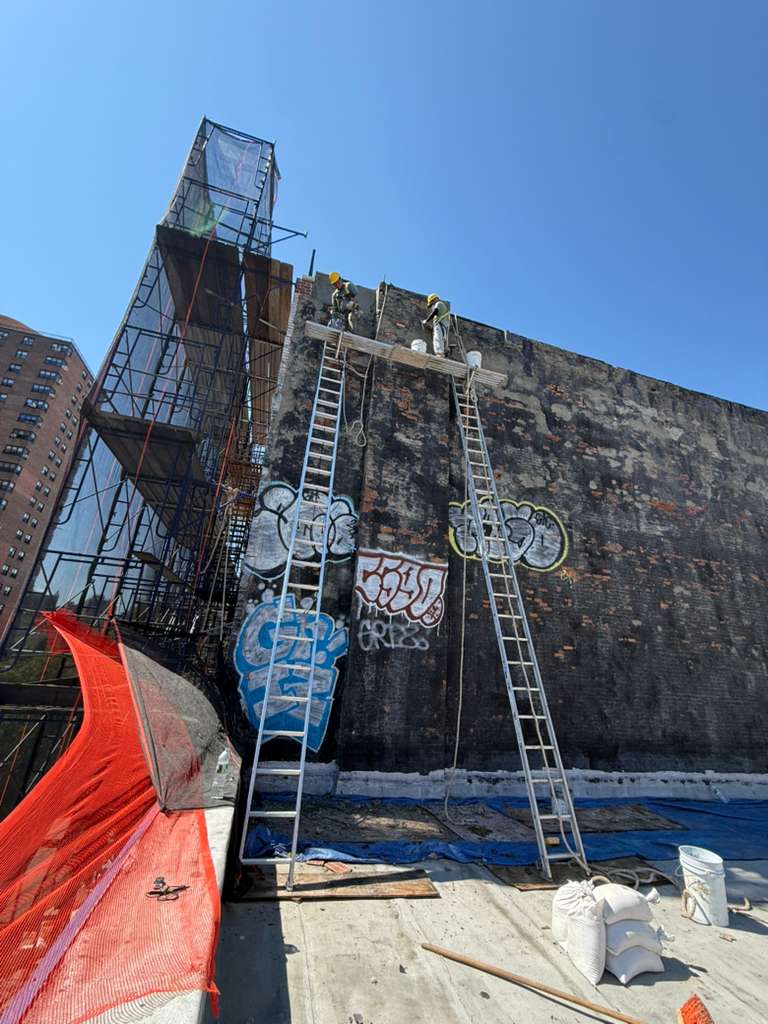
 1. Before
Decades of failed coal-tar parging, spalled brick and open joints. Water was entering across the whole elevation, not at one point.
 2. Masonry repair
Crews cut back to sound masonry from ladder jacks, repointing and repairing the brick before any coating went on.
 3. Coating
A cementitious coat hand-troweled over the repaired wall — thick enough to bridge hairline cracks, breathable enough to let the wall dry.
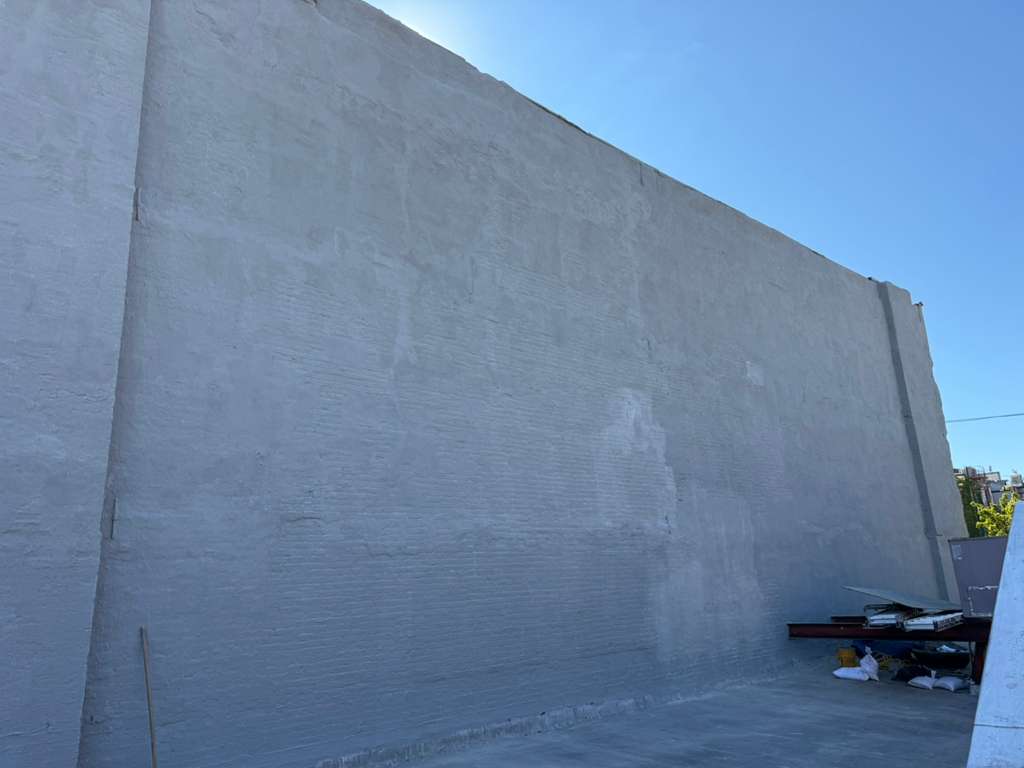 4. Complete
The finished elevation: uniform, sealed against wind-driven rain, and still able to dry to the outside.
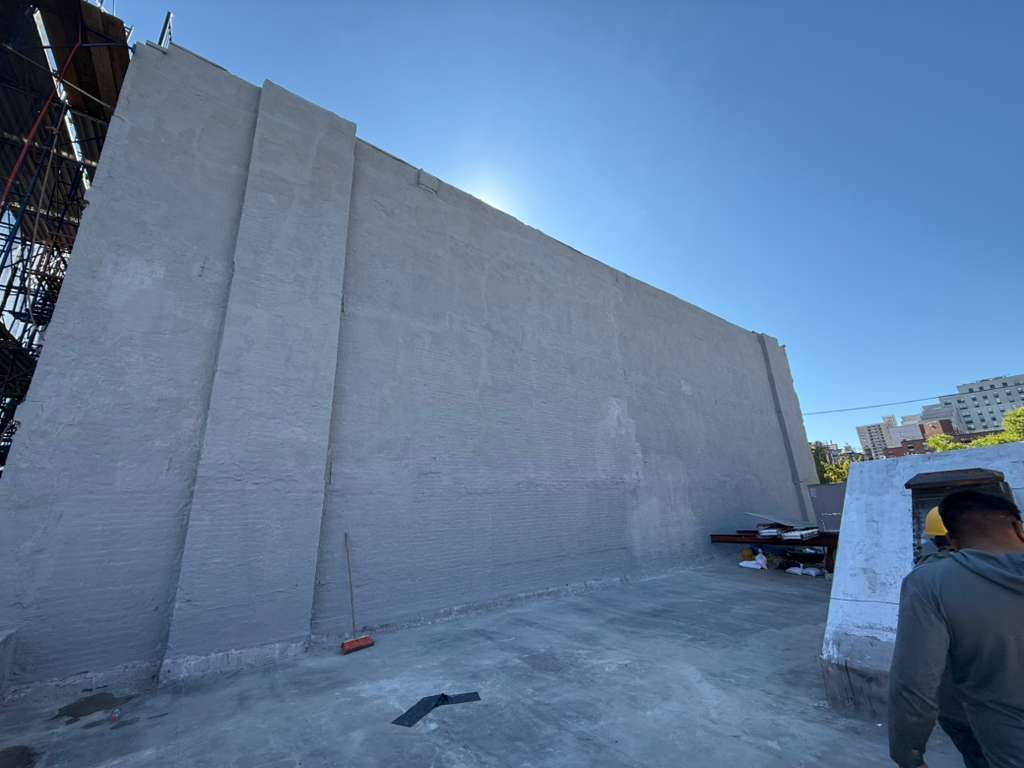
Before & After — Exterior Wall Waterproofing
The same elevation from the same vantage point. Drag the slider to compare the deteriorated wall against the repaired and coated finish.
Why New York Buildings Leak
Four conditions account for most of the water we are called about. Recognising which one you have decides the system — and the cost.
Below-grade seepage
Clay-heavy soil holds water against the foundation after every storm. Most pre-war below-grade walls were built with no membrane at all, so hydrostatic pressure pushes water through the wall and the cove joint where the floor meets it.
Aging masonry envelopes
Mortar is the sacrificial part of a brick wall by design — it fails before the brick does. Once joints open, wind-driven rain enters the wall cavity and travels, often surfacing a floor or two below where it got in.
Failed sealant and flashing
Sealant is the shortest-lived waterproofing on a building. A ten-year-old window bead that has lost adhesion at one edge, or flashing pitched the wrong way, is all the opening a leak needs.
Freeze-thaw cycling
New York winters drive water into hairline cracks, freeze it, and widen them. A crack that only wept last spring can be a running leak two winters later, which is why small repairs deferred get expensive.
Complete List of Waterproofing Services
- Exterior wall waterproofing — breathable repellents and coatings that stop wind-driven rain soaking into above-grade masonry
- Building façade waterproofing — full envelope treatment covering masonry, lintels, shelf angles, flashing and window perimeters
- Brick and masonry waterproofing — silane and siloxane repellents applied after joint and unit repairs, not instead of them
- Thorocoat and elastomeric coating — heavy-bodied acrylic systems that bridge hairline cracks on above-grade masonry and stucco
- Thoroseal waterproofing — cementitious coating that bonds into concrete and masonry to resist hydrostatic pressure below grade
- Stucco waterproofing and repair — crack repair, delamination patching and elastomeric topcoats over restored stucco
- Foundation waterproofing — exterior membrane, protection board and new footer drains installed down to the footing
- Basement waterproofing — interior perimeter drainage, vapor barriers and sealed sump systems for chronic seepage
- Roof waterproofing and leak repair — leak tracing, flashing and seam repair, drain retrofits and targeted membrane work
- Flat roof waterproofing — EPDM, TPO, modified bitumen and liquid-applied membrane systems for low-slope roofs
- Parapet wall waterproofing — both faces plus the cap, with repointing, through-wall flashing and coping joint resealing
- Balcony and terrace waterproofing — traffic-bearing membranes, threshold and railing detailing, and drainage correction
- Concrete waterproofing — crystalline and cementitious systems for concrete walls, slabs, pits and parking structures
- Brownstone waterproofing — repointing, restoration and breathable sealing of historic brownstone façades
- Window caulking and waterproofing — full sealant removal, backer rod and new perimeter joints tooled to a proper profile
- Expansion joint caulking — resealing vertical and horizontal joints with sealants rated for the actual movement
- Brick repointing and tuckpointing — mortar joints cut to depth and repacked with mortar matched to the existing masonry
- Crack repair and waterproof sealing — routing and sealing static cracks, plus polyurethane or epoxy injection for active leaks
- Chimney waterproofing — crown repair, counterflashing, stack repointing and breathable water repellent
- Coping stone joint waterproofing — raking and resealing open joints at the top of parapet and boundary walls
- Exterior leak detection and repair — systematic controlled water testing to isolate the true entry point before opening anything
- Water infiltration repair — permanent repair at the confirmed entry point, verified by retesting
- Emergency leak repair — same or next business day stabilization to stop active water entry
- Commercial waterproofing — envelope programs for multi-family, mixed-use and commercial properties
- Residential waterproofing — single-family, brownstone and small multi-family diagnosis and repair
Waterproofing Cost in NYC & Westchester (2026)
Indicative ranges for New York residential and small commercial property. Every estimate we issue is written, itemized and free.
| Service | Estimated cost | Coverage |
|---|---|---|
| Leak detection & water testing | $450 – $1,200 | Credited toward the repair if you proceed with us |
| Window & joint sealant replacement | $800 – $3,000 | Windows, expansion joints, penetrations |
| Thorocoat / elastomeric coating | $1,500 – $5,000 | Full masonry or stucco wall, above grade |
| Masonry repointing + repellent | $3,500 – $16,000+ | Per elevation, depending on access and joint condition |
| Interior basement drainage system | $4,000 – $12,000 | Full interior perimeter, sump pit and pump |
| Exterior membrane & footing drains | $5,000 – $18,000+ | Full below-grade perimeter, excavation included |
| Roof, balcony or terrace membrane | $6,000 – $22,000+ | Traffic-bearing assembly with drainage course |
Our Waterproofing Process
Four steps, in this order, every time. Skipping the first one is why so much waterproofing fails.
Moisture-Source Assessment
We identify where water enters and how it travels — hydrostatic pressure, surface runoff, roof drainage, or a failed sealant — before recommending any system. Free, and usually within 24 hours.
Surface Preparation
Effective waterproofing depends on prep. We clean, repair and profile the substrate so coatings and membrane systems bond instead of blistering off in two seasons.
System Application
Coatings, membranes and drainage components are installed to manufacturer specification and NYC building code, using commercial-grade materials rated for hydrostatic pressure and freeze-thaw cycling.
Test, Drain & Warrant
We water- or flood-test the assembly, review site grading and drainage so water moves away from the building, and hand over the manufacturer warranty plus our own written labor warranty.
Residential Waterproofing
For homeowners, brownstone owners and small multi-family property, waterproofing is usually a single problem to solve — a wet basement, a leaking balcony, a chimney that stains the ceiling every winter. We diagnose it, price the repair, and do it without turning your home into a job site for a month.
Commercial Waterproofing
For landlords, property managers, and co-op and condo boards, we work at portfolio scale: envelope surveys, prioritized repairs staged across budget cycles, and scheduling that works around tenants and building access. You get written findings with photo documentation at every stage.
Where We Waterproof
Our crews serve all five New York City boroughs and Westchester County. Based in the Bronx since 2009.
- The Bronx
- Manhattan
- Brooklyn
- Queens
- Staten Island
- Yonkers
- White Plains
- New Rochelle
- Mount Vernon
- Scarsdale
- Bronxville
- Valhalla
Waterproofing — FAQ
How much does basement waterproofing cost in NYC?
An interior perimeter drainage system with a sump pit typically runs $4,000 to $12,000 for a New York City basement. Exterior membrane with new footing drains — the more permanent option, but it requires excavation — runs $5,000 to $18,000 or more depending on depth, access, and what has to be moved to reach the wall. Isolated crack injection on poured concrete is far cheaper at $500 to $1,500 per crack. We assess the moisture source first and quote the systems that actually apply, in writing, at no charge.
What is Thorocoat waterproofing?
Thorocoat is a heavy-bodied acrylic coating for above-grade masonry and stucco. It is thick enough to bridge hairline cracks and leaves a uniform finished surface, so it both waterproofs and visually restores a wall in one system. It is often confused with Thoroseal, which is cementitious and belongs below grade where it resists hydrostatic pressure by bonding into the concrete or block. Using one where the other belongs is the single most common cause of coating failure we are called to fix.
Is interior or exterior basement waterproofing better?
Exterior membrane excludes water from the wall entirely and is the more permanent fix, but it needs excavation, which is not always viable on a tight city lot or under a stoop. Interior perimeter drainage manages water that has already reached the wall and routes it to a sump — much less invasive and often the right call in New York. We assess the moisture source and price both so you can weigh the trade-off rather than take our word for it.
How long does exterior waterproofing last?
Penetrating silane and siloxane repellents on masonry last roughly 7 to 10 years before reapplication. Elastomeric coatings run 10 to 15 years. Sheet and liquid membranes on roofs and terraces run 15 to 25 years depending on the system and foot traffic. Sealant joints are the shortest-lived element at 7 to 12 years, which is why they are the most common source of a new leak in an otherwise sound building.
Can you find a leak if we do not know where the water is coming from?
Yes — that is usually the first thing we do. Water rarely enters where it appears, because it travels along framing, ducts and pipe chases first. We use systematic controlled water testing, isolating one element at a time from the lowest suspected entry point upward, until the leak reproduces and the entry point is confirmed rather than guessed. That way you pay for one correct repair instead of several wrong ones.
Do you waterproof occupied and commercial buildings?
Yes. Most of our waterproofing work is on occupied residential, mixed-use and commercial buildings, including co-op and condo boards and managed portfolios. We stage work around tenant access and building operations, schedule to budget cycles where a board needs it, give advance written notice of anything affecting entry or noise, and provide photo documentation at every stage.
Free Waterproofing Assessment
Tell us what you are seeing — a damp wall, a stained ceiling, a balcony that leaks into the unit below. We will find where the water is actually entering, price the repair in writing, and give you a realistic timeline. No cost, no obligation.